
february 2, 2026
los angeles guitar quartet at the town hall
PROGRAM NOTES BY WILLIAM KANENGISER
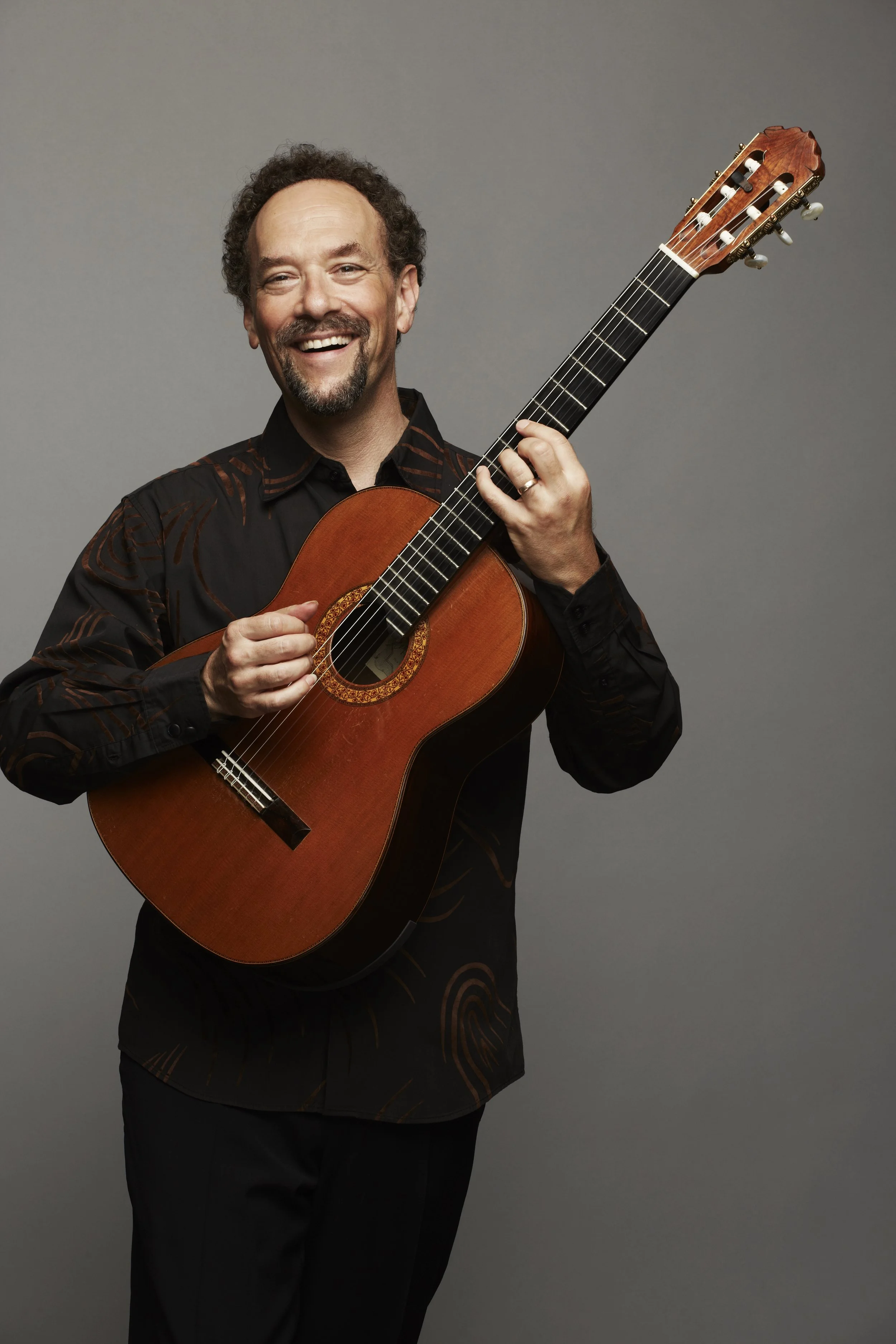
William Kanengiser (PC Jiro Schneider)
Samuel Coleridge-Taylor was born in London to an English mother and a father from Sierra Leone, Africa. Although raised in England, he came to embrace the music of America, most notably in his popular trilogy of cantatas “Song of Hiawatha”, and numerous works informed by African American musical influences. A prolific composer and active conductor, his career was tragically cut short at age 35, but not before he earned the respect of musicians and nobility across Europe and the US. He ultimately earned the moniker of the “African Mahler” (although this writer might suggest that “African Dvorak” would be more apt). His Danse Négre is the finale to a four-movement work entitled African Suite, originally written for piano, but subsequently arranged for full orchestra by the composer. Featuring a rousing introduction and ebullient theme, the piece moves to a middle section reminiscent of a spiritual and ends with a brilliant codetta. The simplicity of the themes belies a sophisticated sense of structure and harmonic inventiveness, and the piece seems to lend itself gratefully to this recasting on four guitars.
In anticipation of the 250th anniversary of the United States Declaration of Independence from British rule, LAGQ presents a set of pieces by a composer who helped to define the archetypal “American sound”. Despite being born in Brooklyn, Aaron Copland was able to capture the essence of the pioneer and Wild West experience in pieces like Rodeo, Billy the Kid, and Appalachian Spring. LAGQ’s William Kanengiser undertook the challenge of adapting three examples of Copland’s masterful orchestrations to that most iconic instrument of the American experience, the guitar. The finale of Appalachian Spring features Copland’s variations on the traditional Shaker melody “The Gift to be Simple”, exploring the quartal harmonies and open sonorities emblematic of his style. This is followed by two movements from Copland’s Four Dance Episodes from Rodeo: Corral Nocturne paints a portrait of the hushed nighttime atmosphere of the prairie, a backdrop for The Cowgirl’s pining for the love of The Head Wrangler. Hoe-Down has earned its place as one of Copland’s most popular works, a favorite of the concert stage as well as the soundtrack for many ad campaigns. In fact, Kanengiser first discovered this piece in the rock adaptation by Emerson, Lake and Palmer, and performed it at his high school “battle of the bands” on electric guitar. In adapting it for LAGQ, he found the figurations, strummed chords and percussive effects to be very amenable to classical guitars. Copland quoted two square dance tunes (“Bonyparte” and “McLeod’s Reel”) as source material for his vibrant and raucous portrayal of The Cowgirl’s comeuppance.
Certainly, the Moonlight Sonata (1st movement of Sonata #14 in C# minor, Op, 27 #2, “Sonata Quasi una fantasia”) by Ludwig van Beethoven needs no introduction. It stands as one of Beethoven’s most recognizable works for solo piano, eclipsed perhaps only by Für Elise in popularity. Stunningly modern in its day (composed in 1801) it became one of Beethoven’s most-requested pieces after his premiere of the work in 1802 (apparently, he played so forcefully in the 3rd movement Presto agitato that a number of piano strings snapped!). The evocative Adagio sostenuto movement features undulating arpeggios murmuring under a melody that Berlioz described as “a lamentation”. With the instructions that “the entire piece should be played with the greatest delicacy and without dampers”, it explores the full resonance of the lower tessitura of the piano in its most delicate dynamic range. The baritone voicing of the work lends itself well to the guitar, which already sounds an octave lower than written (although a number of the lowest bass notes traverse even the extended range of John Dearman’s 7-string guitar). The challenge in William Kanengiser’s arrangement was to attempt to mimic the resonant sustain of the piano, and the subtle pedaling effects that create its haunting atmosphere. Although every arrangement carries its own set of compromises, it is hoped that this one will shed new light on a much-loved Beethoven classic.
In this set of “Imagens do Brasil” (Images of Brazil), LAGQ pays tribute to the rich sonorities and infectious rhythms of Douglas Lora’s home country of Brazil. The three selections presented here begin with a tune by the idiosyncratic jazz musician Hermeto Pascoal, sometimes referred to as the “Frank Zappa of Brazil”. His De Sábado pra Dominguinhos' is a fine example of the endless fount of tunes and surprising harmonic changes that characterize his music. This is followed by a piece by the great Heitor Villa-Lobos, one of Brazil’s most celebrated classical composers, and a favorite among guitarists. His A Lenda do Caboclo (the Legend of the Native) was originally written for piano, and it features a gently gliding melody interrupted by a bow to the French Impressionist school. The set concludes with A Furiosa by the prolific guitarist/composer Paulo Bellinati, which was written for LAGQ. Inspired by the traditional brass bands that performed in small Brazilian villages, it begins with a mysterious introduction imitating the nature sounds of the Amazonian jungle and then opens to a joyous version of the Maxixe (an antecedent to the samba), ending with a percussive interlude in imitation of the traditional batucada.
Johann Sebastian Bach’s Six Brandenburg Concertos take their place as some of the most beloved works in his extensive oeuvre. Composed in 1721 during his residency in Cöthen, they were dedicated to Christian Ludwig, Margrave of Brandenburg-Schwedt. They were composed following the tradition of Correlli’s and Handel’s magnum sets of concierti grossi. These pieces explore the coloristic and antiphonal effects of mixed instrumentation, as well as dividing the musicians into soloistic roles (ripieno) and full ensemble (concertino). The 3rd Brandenburg is somewhat unique among the other five of Maestro Bach; as opposed to mixed instruments, it is scored for strings alone, and for low strings at that. Violas, not violins, carry the highest parts in the group. This makes it especially amenable to a guitar adaptation, with the guitar’s similar tessitura. Scott Tennant’s arrangement of the third movement was inspired by the version he “grew up” listening to, by his mentors Los Romeros. But he included the extended range of John Dearman’s 7-string guitar, keeping the full range of Bach’s original (despite changing the key from G major to D major).
As a foil to the preceding Bach prelude and fugue, LAGQ features a composition by their newest member, Douglas Lora. Maracasalsa is cast in the form of a prelude and fugue, with the imitative counterpoint and thematic unity of the Bacchian model but rooted in traditional Brazilian rhythms. Based on the maracatú, an ancient dance-form descended from the Afro-Brazilian culture of the northern state of Pernambuco, Maracasalsa playfully explores the rhythmic interplay of superimposed motives, as well as unexpected harmonic and textural changes. This technically and musically challenging work was written when Douglas was only 25 years old and serves as a bridge to the exploration of Brazilian works that follow.
Although he has arranged dozens of pieces for guitar and guitar quartet, LAGQ’s William Kanengiser has written only a handful of original compositions, all for four guitars. "Air & Ground" was the third work he penned, following two other pieces for LAGQ, Mbira and Gongan. "I actually consider this my first original composition," says Bill, "in that it wasn't directly imitating a particular ethnic tradition, such as African or Indonesian music. The first thing that came to me was the title, which I found intriguing because of its double meanings. 'Air' is a Baroque term for song, and 'ground' refers to a type of Baroque variation developed upon a repeating bass line. These terms suggested the general idea of a slow lyrical introduction followed by a more forward-moving section. The non-musical connotations of air and ground - the sense of yearning upwards towards the sky and being tempered by a downward pull to the earth - yielded the germ of the melodic material (G# reaching up to A and falling back down to G#) and gave me an emotional context for the piece. As I discovered my own compositional voice, I found myself being surprised by where it took me. Although I began with neo-Baroque leanings, I somehow ended up in bluegrass country, with a banjo-inspired stomp!"
Hungarian-born Franz Liszt was a unique “sibling” indeed amidst a formidable “brotherhood” of composer/performers (such as Chopin, Paganini, Kreisler, and Rachmaninov, to name a few) whose music and peerless virtuosity on the piano made him an international superstar of his time.
As was common and, most likely, expected of a composer such as Liszt, he dove deeply into his ethnic roots for those pearls that would make his music truly and unmistakably Hungarian. Bela Bartok would later praise Liszt and his music, particularly the Hungarian Rhapsodies, calling them “perfect creations”, while at the same time hastily pointing out that the material Liszt was using was essentially Gypsy, and not entirely Hungarian.
The second of Franz Liszt's Hungarian Rhapsodies is one of his better-known works. It was originally composed in 1847 as a solo piano piece dedicated to the Count László Teleky and published in 1851. An orchestral version followed soon thereafter. Most of his rhapsodies, including this one, are comprised of two parts: a slower and expressive part which Liszt marks Lassan (lassu), and a final section marked Frisska (friss) which builds up in intensity into a frenzied swirl.
On a contemporary note, the piece has found its way into the television and film media, appearing in such favorites as the Bugs Bunny "Rhapsody Rabbit" episode, and the movie "One Hundred Men and a Girl".
© William Kanengiser